

The Sharing Party: Earning Nature Pounds🌿
🌿 How Nature Pounds Work in the Transitional Economy
The introduction of Nature Pounds adds a tangible, transitional bridge to our Economic Decoupling strategy. Because the United Kingdom Moneyless Society (UKMS) is currently in its active, transitional build phase, introducing a physical currency pegged directly to the living biosphere allows citizens to stop relying on debt-backed sterling (£) for their daily survival while retraining society to value and protect the natural world.
Unlike legacy currency—which is backed by central bank debt and endless extraction—Nature Pounds are backed by verified ecological health and physical access to the Caretaker Commons, moving society step by step toward our fully automated, moneyless future.
| Currency Feature | Legacy Sterling (£) | Nature Pounds (Transitional Currency) |
|---|---|---|
| What Backs Its Value | Central bank debt, speculation, and corporate extraction. | Living Nature. Pegged directly to verified ecological health, soil regeneration, and biodiversity monitored by the Sensor Grid. |
| Physical Form | Polymer notes and corporate banking ledgers. | Biodegradable Physical Notes printed with organic inks via automated depots and embedded with Digital Product Passports (DPPs). |
| Core Purpose | Paying rent, taxes, and shareholder profits. | Daily Survival & Stewardship. Used to access food, shelter, and community goods during the transition away from capitalism. |
| Redemption Mechanic | Buys private property deeds and encloses land. | Grants Access to a Piece of Nature. Redeeming Nature Pounds unlocks direct, non-destructive stewardship access to reclaimed Community Land Trusts (CLTs), organic allotments, timber, and clean water reserves—never private ownership. |
⚙️ The Three-Step Nature Pound Lifecycle
- Pegged to Ecological Health (The Faith Mechanic):
- The Resource Treasury—operating under the full, direct control of the elected government—issues physical Nature Pounds strictly within the ecological headroom calculated by the AI Advisor.
- Because the currency's supply and value are pegged directly to the health of local ecosystems (such as reclaimed urban land trusts in Hackney or socialised water grids), citizens have genuine faith in the currency: when nature thrives, Nature Pounds hold their strength; if nature is degraded, issuance stops. Protecting nature becomes everyone's immediate material interest.
- Circulating for Daily Survival:
- Rather than hoarding legacy sterling (£) to pay corporate landlords and supermarkets, citizens—across all three engagement levels (Community Supporter, Ecosystem Participant, and Full Sovereign Member)—begin trading Nature Pounds within local mutual-aid hubs, cooperative markets, and Caretaker Guild networks to secure their daily survival needs.
- Redemption: Access to a Piece of Nature (Not Ownership):
- In strict compliance with Natural Law (no human created nature, so no one can own it), redeeming a Nature Pound never transfers a private property deed. Instead, redeeming Nature Pounds grants a defined right to participate in the sustainable use of natural resources held within the Caretaker Commons. Such rights include:
- Agricultural land: A Nature Pound redemption grants participation rights in a community growing area, including a defined share of cultivation capacity and harvest.
- Woodland: This redemption allows participation in approved woodland management, collection of designated renewable materials or other permitted forestry activities.
- Water resources: It provides rights to engage in carefully regulated fishing, water stewardship, and other approved activities, all while adhering to water quality and ecological limits.
- Renewable energy resources: A Nature Pound redemption grants a defined entitlement to participate in the output of a designated community renewable energy installation.
⛏️ The Paradigm Shift: Gold Mining vs. Biosphere Caretaking
Under the old gold standard, human beings dug destructive holes in the earth to extract inert metal to back fiat money. Under the Nature Pound standard, citizens register with the elected government as Caretakers, heal and regenerate the living biosphere, and mint physical Nature Pounds directly through verified ecological stewardship.
| Economic Dimension | Legacy Gold Standard (Capitalism) | The Nature Pound Standard (UKMS Transition) |
|---|---|---|
| How Currency is Minted | Destructive Extraction. Mining companies tear up ecosystems to extract inert gold ore. | Regenerative Stewardship. Registered Caretakers restore soil, plant trees, clean rivers, and protect biodiversity. |
| Who Controls Issuance | Private mining corporations, bullion banks, and central financiers. | The Elected Government & Resource Treasury, audited against real-time Sensor Grid telemetry. |
| Impact on the Planet | Depletes finite natural resources and poisons local water tables | Expands Ecological Headroom. Every newly minted Nature Pound represents a measurable improvement in planetary health. |
| Redemption Value | Exchanged for hoarded metal bars or private property enclosures. | Grants Access to a Piece of Nature. Redeeming Nature Pounds unlocks stewardship access to Community Land Trusts (CLTs), organic harvests, and clean natural spaces—never private ownership. |
🌱 How Citizens "Mine" Nature Pounds in Four Steps
Because the United Kingdom Moneyless Society (UKMS) is actively building its parallel economy, any citizen—whether a Community Supporter, Ecosystem Participant (Part-Time), or Full Sovereign Member (Full-Time)—can earn Nature Pounds for their daily survival:
- Register with the Government as a Caretaker:
- Citizens sign the Declaration of Common Heritage and register through the digital portal (or at a local municipal hub like Hackney Council) as an official Caretaker, linking their Digital Caretaker Pass to the Department of Ecological Stewardship & Agriculture (TBC).
- Perform Verified Environmental Caretaking:
- Caretakers take on ecological restoration tasks—such as rewilding urban plots in East London, restoring soil health in Community Land Trusts, cleaning polluted waterways (like the rivers degraded by corporate monopolies such as Thames Water), or maintaining biodiversity corridors.
- Telemetry Verification & Minting:
- The nationwide IoT Sensor Grid and Digital Product Passports (DPPs) verify the measurable ecological gain. Because the currency is pegged directly to the biosphere, the Resource Treasury (under the full control of the elected government) authorises the automated depots to print and issue physical Nature Pounds directly to the Caretaker.
- Circulate for Survival or Redeem for Nature Access:
- Caretakers use their earned Nature Pounds within the parallel economy to secure daily survival goods (food, shelter, and mutual-aid services) instead of relying on legacy bank sterling (£)—or redeem them directly for physical access to a piece of nature within the Caretaker Commons.
You no longer have to beg corporate employers for devalued sterling: by registering as Caretakers and healing your local environment, you become the creators of a currency backed by living, breathing nature.
How an organisation earns Nature Pounds
The Sharing Party is not proposing to issue Nature Pounds only to individual volunteer caretakers. It also offers them to public authorities, utilities and other organisations in return for independently verified environmental improvements.
This makes Nature Pounds a potential incentive and exchange mechanism for environmental performance across the local economy.
Organisations and individuals can earn Nature Pounds in the following ways:
-
Environmental caretaking by individuals or community groups: participants undertake agreed work, achieve verified results and receive Nature Pounds.
-
Environmental performance by organisations: an organisation undertakes an agreed environmental improvement, demonstrates the result through independent verification and receives Nature Pounds under a defined reward agreement.
For example, Hackney Council might undertake an agreed air-quality improvement programme. Thames Water might undertake verified work to reduce pollution entering a river or waterway. If the agreed outcomes were independently demonstrated, the organisation could receive Nature Pounds.
Our organisational model: Steps to acquiring Nature Pounds
-
Environmental agreement
The Sharing Party agrees a specific environmental task and measurable target with the organisation.
-
Work is undertaken
The organisation carries out the agreed work, such as reducing air pollution, restoring a habitat or reducing sewage pollution.
-
Independent verification
Evidence is assessed against an agreed baseline to establish whether the environmental improvement actually occurred.
-
Nature Pound reward
The Resource Treasury authorises a reward based on the verified environmental outcome and the applicable issuance ceiling.
-
Goods and services
The organisation uses its Nature Pounds to obtain eligible goods and services from participating providers who voluntarily accept them.
Examples of potential agreements
An agreed programme to reduce pollution in a defined area through measures such as traffic reduction, green infrastructure or emissions reduction. Monitoring would establish the improvement against the baseline.
Thames Water — cleaner waterways
An agreed programme to reduce pollution entering a watercourse, improve wastewater performance or support river restoration. Independent water-quality and pollution evidence would be required.
Other organisations — ecological restoration
Charities, businesses, housing associations and community organisations could earn Nature Pounds for verified improvements to habitats, soil, biodiversity and other environmental resources.
Five Established Rules
-
Additional improvement: Rewards should be given for measurable improvements beyond what the organisation is already legally required to do, unless a specific agreement states otherwise.
-
Independent evidence: Organisations cannot simply declare their own success and issue rewards without independent validation.
-
Outcome-based rewards: The reward amount should reflect the scale, quality, durability, and ecological significance of the verified improvement.
-
No double counting: The same environmental improvement cannot be claimed by multiple organisations or rewarded twice.
-
Controlled redemption: Nature Pounds can be spent only with participating providers under published acceptance and redemption arrangements.
It is important to note that our reward mechanism is not intended to pay organisations for compliance with existing environmental laws. Instead, it aims to promote additional improvements, innovation, and restoration.
Case Study: Will there be enough money in circulation if money is minted in this way?
Yes—because ecological damage under legacy capitalism is vast, there is an enormous reservoir of restoration work to be done, ensuring that more than enough Nature Pounds can be minted to meet citizens' daily survival needs during the transition.
Unlike legacy gold mining—which was constrained by scarce, finite metal deposits hidden underground—biosphere caretaking is backed by the immense volume of degraded land, polluted waterways, depleted soils, and urban ecosystems across the UK that require active healing.
1. Why Supply Meets Human Need (Without Artificial Scarcity)
- Abundant Ecological Work: Centuries of industrial extraction have left millions of acres of soil depleted and waterways contaminated (such as the rivers degraded by corporate monopolies like Thames Water). Every river cleaned, tree planted, and urban plot rewilded generates verified Ecological Headroom on the Sensor Grid, allowing the Resource Treasury to mint fresh Nature Pounds directly into Nature Capital accounts.
- Matched to Population: Because every citizen can register as a Caretaker—whether as a Community Supporter, part-time Ecosystem Participant, or full-time Full Sovereign Member—currency issuance scales naturally with the size of the participating workforce and the community's immediate survival requirements.
- No Hoarding Bottlenecks: Unlike sterling (£), which is hoarded in offshore accounts and speculative property portfolios, Nature Pounds circulate rapidly for daily essentials (food, shelter, mutual-aid services) and are regularly redeemed for physical access to a piece of nature within the Caretaker Commons.
2. Balancing Currency Supply with Planetary Limits
To ensure the currency stays strong and avoids inflation, the Resource Treasury (operating under the full, direct control of our elected government) manages issuance across three clear guardrails:
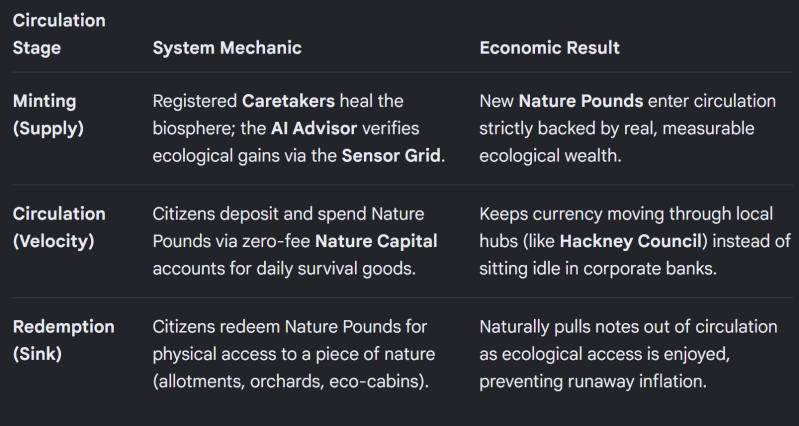
3. The Ultimate Goal: Outgrowing Currency Altogether
Even if ecological restoration reaches peak abundance, Nature Pounds are explicitly designed as a transitional decoupling bridge, not a permanent replacement for our ultimate vision. As more citizens mint Nature Pounds and build out our Community Land Trusts (CLTs) and automated infrastructure, society steadily transitions into the fully un-paywalled baseline—where survival needs are met permanently without any currency at all.
Case Study 2: You Can't Build Green Infrastructure Without Credit First
Transitioning off fossil fuels requires spending trillions of pounds before the planet gets cleaner.
- The timing mismatch: Installing wind farms, upgrading power grids, and converting factory farming to regenerative agriculture takes years of upfront labour and materials.
- The consequence: Under a strict planetary lock, new money cannot be created until the biosphere measurably improves. Society would be trapped in a "chicken-and-egg" deadlock: unable to mint the money needed to fix the planet because the planet isn't fixed yet.
The solution:
This model actually fixes the "chicken-and-egg" funding problem we talked about earlier! By having the bank issue upfront credit first so citizens can afford to clean the river, and then letting everyone's savings (Nature Pound) grow stronger once the water is clean, we create a powerful collective incentive:
- Upfront Seed Capital: The bank lends or grants money to buy cleanup gear, test water quality, and pay workers while the river is still polluted.
- Community Peer Pressure: Because a polluted river makes everyone's bank account weaker, citizens actively stop factories or neighbours from dumping waste—protecting the river becomes protecting their own savings.
- Shared Reward: Once sensors verify the river is clean, the currency rises in purchasing power, rewarding the entire community simultaneously.
Two Real-World Flaws Still Left to Solve:
Even with upfront bank funding, this clever loop still hits two major human and economic traps if applied to an entire nation's currency:
- The "Free-Rider" Problem (Gresham's Law in Action): Suppose you work hard for six months pulling rubbish out of the river, while your neighbour sits at home watching TV. When the river gets clean, both of your bank accounts rise in value by the exact same amount. In fact, your neighbour comes out ahead because they kept all their energy while still getting the currency boost. Over time, people stop volunteering and wait for everyone else to do the work.
- The "Hoarding" Trap: If people know their money will automatically get stronger next year once the river is clean, nobody wants to spend money today—why buy a sandwich for £5 today when that same £5 will buy two sandwiches after the cleanup? When everyone hoards cash waiting for it to appreciate, shops close, businesses stop hiring, and the local economy freezes (known in economics as a deflationary spiral).
The Solution:
We use upfront bank credit to fund cleanup and tie the financial reward to verified ecological recovery:
- Targeted Rewards Instead of Universal Currency Appreciation: Instead of making everyone's bank account rise equally (which causes hoarding and free-riding), the bank gives interest-free loans for the river cleanup, and cancels the debt (or pays a direct cash bonus) specifically to the people and groups who did the verified cleanup work.
- Keep Everyday Cash Steady: Ordinary wages and grocery prices stay in stable, everyday currency so shops stay open, and nobody hoards money waiting for it to rise.
- Community "River Shares": Citizens who help clean the river earn local ecological bonds backed by the water utility or local council. Once the river is clean—saving the town millions in water treatment costs—those savings are paid out as dividends directly to the citizens who did the work.
How to Fix the Hoarding Problem
Combining demurrage with a biosphere-linked currency is actually one of the smartest ways to fix the hoarding trap we just discussed.
How Demurrage Solves the Hoarding Problem
In a normal system where cleaning the planet makes currency grow stronger, sitting on cash is profitable. Adding a small "holding fee" (for example, losing 0.5% to 1% of its value every month it sits idle in an account) completely flips human behaviour:
- Fast Circulation: Nobody hoards cash under a mattress or in idle accounts; people spend it quickly on local goods, wages, and ecological restoration projects before the fee kicks in.
- No Deflationary Freeze: Even as the biosphere heals and the currency's overall purchasing power improves, the monthly holding fee ensures money keeps flowing through shops, farms, and green businesses every single day.
- Built-In Funding Pool: The small monthly fee collected from idle money can flow straight back into a community biosphere fund to pay for river cleanups, tree planting, and renewable energy.
How to Apply Demurrage to Physical Notes Without Hassle
Modern currency design makes applying demurrage to physical notes far easier than it was in the 1930s:
- Date-Stamped "Expiry" Series (Easiest for Everyday Use): Physical Nature Pound notes are printed with clear seasonal or annual validity bands (for example, a note loses 2% of its face value every six months, printed right on the corner table of the note). Shopkeepers see the current face value at a glance, and old series are swapped at banks or post offices each year.
- Small Cash-Free Exemption Threshold: To protect everyday pocket money without inviting large-scale hoarding, the system can exempt the first £100–£250 held in a citizen's personal wallet or primary account, while applying universal demurrage to all larger digital balances and high-denomination notes.
- Digital-First Design with Smart Cards: For offline or non-smartphone users, physical tap-to-pay Nature Cards hold balances electronically without needing a bank app—allowing demurrage to apply automatically while keeping payments as simple as handing over a note.
In short, applying demurrage universally across both digital balances and physical notes keeps the currency unified, prevents cash hoarding, and ensures the holding fee flows reliably back into restoring the biosphere.
Problem: The "Recession Spiral" During Ecological Disasters
Money is the circulatory system of society—it pays nurses, truck drivers, farmers, and builders.
- What happens under a total lock: Suppose a massive volcanic eruption, super-El Niño drought, or wildfire wipes out 10% of global forest cover in a single summer. Because the planet's biosphere score just dropped by 10%, the world's money supply would immediately shrink or lose 10% of its value.
- The consequence: Banks would freeze loans, businesses would go bankrupt, and millions of people would lose their jobs—at the exact moment humanity needs massive funding to fight fires, replant forests, and feed displaced communities.
The Solution: How a smoothed, multi-year ecological peg (using 5- or 10-year rolling averages) would work in practice to ignore temporary weather shocks.
A smoothed, multi-year ecological peg works like a financial shock absorber. Instead of letting a single wildfire, flood, or drought crash the money supply overnight, the currency's value and supply are tied to a 5- or 10-year rolling average of ecological health.
1. How the Rolling Average Works in Practice
Imagine a country or bioregion measures its biosphere health every quarter using satellite imagery, river sensors, and soil carbon audits, generating an Ecological Health Score (for example, starting at 100).
- Raw Annual Score (Volatile): Changes every year based on weather, harvests, fires, and restoration projects.
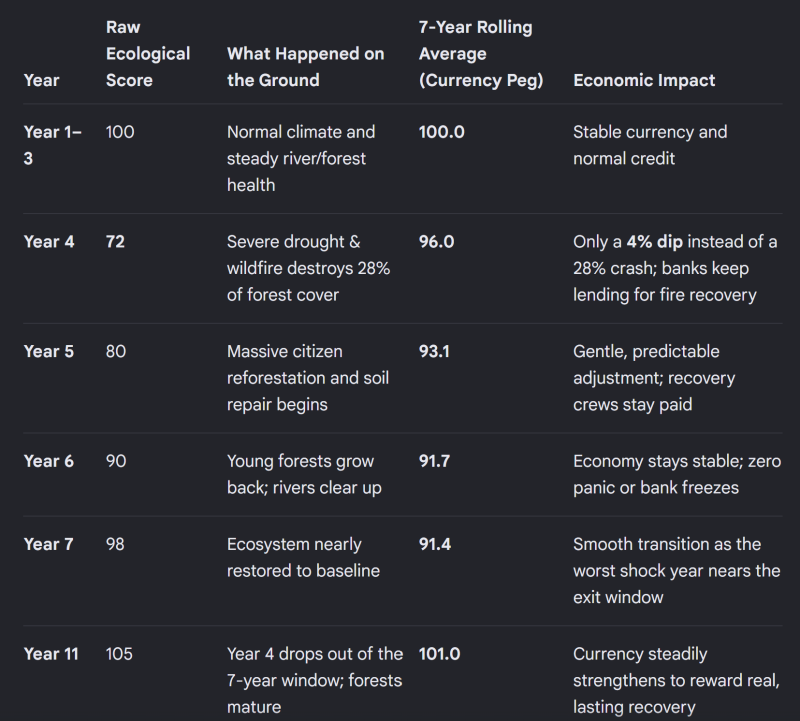
- 7-Year Rolling Average (Smoothed Peg): Every year, the central bank drops the oldest year's score and averages the most recent seven years together. That smoothed number determines the currency's backing strength and how much new credit banks can issue.
Example: Surviving a Major Drought and Wildfire
Suppose a region starts at a healthy score of 100, then suffers a severe wildfire and drought in Year 4 that drops its raw ecological score to 72, before communities replant and recover over the next three years:
2. Three Built-In Safety Valves That Make It Work
To ensure global currency traders or local banks do not panic when a disaster hits in Year 4, a practical multi-year peg relies on three operational rules:
- Emergency Restoration Credit Line: Whenever a verified natural disaster occurs, the central bank automatically unlocks a temporary, interest-free credit pool exclusively for emergency relief and replanting. Because the rolling average gives the country 5 to 10 years to restore the damaged ecosystem before the peg fully reflects the loss, the economy gets the exact breathing room it needs to heal the land first.
- Ecological Buffer Reserves (Like a Grain Silo): Just as central banks hold foreign currency reserves to smooth out trade swings, an ecological central bank maintains a verified ecological surplus—protecting extra wetlands, peatlands, and marine reserves above the minimum required for the peg. If a wildfire damages one forest, those surplus reserves absorb the blow without shrinking the money supply.
- Separate "Shock" vs. "Trend" Tracking: Satellite and AI monitoring can tell the difference between a temporary weather shock (a dry summer that recovers next spring) and human destruction (clear-cutting a forest for mining or waging war). Weather shocks get smoothed over 7–10 years, while deliberate human destruction triggers immediate financial penalties on the polluters responsible.
3. Why This Fixes the Core Debate
- Ignores Weather Noise: A single bad storm or dry summer cannot trigger a recession, bank freeze, or speculative currency attack.
- Still Enforces Long-Term Discipline: You cannot cheat a 7-year rolling average forever. If a nation ignores climate change, pollutes its rivers, or wages destructive wars year after year, the rolling average steadily falls—forcing genuine accountability without causing sudden chaos.
What Remains When We Combine All These Ideas
A Closer Look at the system we have just pieced together step by step:
- Backed by the Biosphere: The currency's long-term health is anchored to verified ecological restoration (clean rivers, healthy soil, carbon sinks), penalising pollution and war.
- Upfront Bank Credit: Banks issue seed money upfront so citizens and towns have the tools and wages to restore damaged ecosystems first.
- Smoothed Averages: Multi-year rolling averages stop temporary droughts or storms from crashing the economy.
- Demurrage (Time-Decay): A gentle holding fee stops anyone from hoarding the currency, forcing wealth to circulate continuously into productive, green work.
At this point, we are no longer describing a crude, brittle gold-style peg—we have essentially designed a modern regenerative currency (very close to cutting-edge proposals by ecological economists like Bernard Lietaer). The remaining challenges are no longer about whether the logic works, but purely practical ones: how to verify ecological health fairly without corruption, and how to stop powerful governments or corporations from overriding the rules during a war or political crisis.