the Moneyless society
A New Way to Live: Welcome to The Sharing Party’s Moneyless Society
Dear Citizens,
The results are in, and the future has officially arrived. Thanks to your historic participation and overwhelming support, The Sharing Party has won the online election. Today, we are proud to announce that we are officially stepping forward to govern a new, parallel Moneyless Society.
We heard your call for a system that values human dignity over financial profit. This government will not be defined by banks, debts, or fiat currency. Instead, we are building a society rooted entirely in mutual aid, resource sharing, and collective cooperation. Through our digital network, your contributions to the community—whether through your skills, your time, or your care—will directly sustain the community, ensuring that everyone’s basic needs are met without the burden of money.
We are choosing cooperation over conflict. We are not here to overthrow the existing state, but to render its economic pressures obsolete. You can continue to navigate your external obligations while fully immersing yourself in our shared ecosystem for your daily life, sustenance, and community support.
You are formally invited to join us.
By logging into our official digital portal, you can register your skills, browse our community resource networks, and begin participating in a truly collaborative economy today.
Let’s build a world where we share more and stress less.
In solidarity and shared hope,
The Executive Council of The Sharing Party
An Invitation to Workers: Reclaim Your Labor and Join the Caretaker Economy
Dear Workers,
You are the backbone of society, yet the system you sustain is breaking you. Following our victory in the online election, The Sharing Party formally invites you to leave the exhausting cycles of capitalism behind and join our nationwide, Moneyless Society.
To build a better future, we must look honestly at how the old system began. Capitalism did not start with fair trade. It began with the violent privatization of shared lands and the brutal displacement of Indigenous peoples from the resources they had stewardship over for generations. Today, an overwhelming number of workers no longer want to be associated with a system that began with exploitation and continues to treat human beings as replaceable cogs in a corporate machine.
Under capitalism, you sell your time, your health, and your creativity just to survive, while the wealth you generate accumulates at the top. We believe there is a better way to live. Our moneyless society operates on a fundamental truth: we are not owners of the Earth, but caretakers of its natural resources for all of humanity.
When you join us, you stop working for corporate profit and start working directly for human well-being. In our parallel economy:
- Your labor belongs to you: Your skills, whether in trade, care, technology, or logistics, are contributed directly to the community. No bosses, no exploitation, and no artificial performance metrics.
- Your basic needs are guaranteed: Because we manage resources collectively, your access to food, housing, healthcare, and community support is guaranteed by the network—not dependent on a paycheck.
- We steward the Earth together: You will be part of a workforce focused on rebuilding local ecosystems and infrastructure, treating the planet as a shared trust rather than a corporate asset.
You do not have to spend the rest of your life sacrificing your well-being for a system that doesn't care about you. By registering through our digital portal today, you can begin transitioning your labor away from capitalist exploitation and into a community designed to support you.
Step away from the debt, the burnout, and the legacy of a broken system. Reclaim your labor, and let’s become caretakers of our shared future together.
In solidarity,
The Executive Council of The Sharing Party
Garden of Eden

The Garden of Eden is the biblical, paradisiacal earthly home created by God for Adam and Eve in Genesis, representing a state of perfect innocence, harmony, and communion with God. Located in the east, it featured the Tree of Life and the forbidden Tree of Knowledge of Good and Evil
Access Over Ownership
This shift from individual ownership to universal user-access is the exact mechanism that allows the European Technate to provide free goods and services while remaining under its strict 2.2-gigaton carbon budget.
In a traditional market economy, the goal is to sell as many units of a product as possible, which leads to massive underutilization (e.g., a personal car or power tool sitting idle in a garage 95% of the time). In a human-centric Technate, the goal is to maximize the utilization rate of every piece of matter, minimizing the carbon footprint per user-hour.
Here is how a society functions when you own nothing but have access to everything.
1. The Access vs. Ownership Paradigm
Because goods are free, the concept of status through possession completely dissolves. Instead, citizens are granted unhindered usufruct rights—the legal and social right to use and enjoy something, provided it is returned undamaged to the system.
| Property Category | In a Market Economy (Ownership) | In the Technate (Access Economy) |
|---|---|---|
| Housing | Bought, sold, or rented. Real estate acts as a financial asset or debt. | Allocated based on family size and structural availability. Managed entirely by the Social Architecture Sequence. |
| Vehicles & Transit | Privately owned, requiring insurance, maintenance, and parking space. | A continuous, automated on-demand fleet. You summon a vehicle when needed; it handles its task and routes itself to the next user or cleaning hub. |
| Tools & Equipment | Purchased for occasional use, leading to immense physical waste. | Checked out from local automated distribution and hobby hubs. Returned when the task is complete. |
| Personal Effects | Clothing, electronics, and bedding are private property. | Clothing and daily items are yours to keep for their lifecycle, but are designed for modular recycling return when worn out. |
2. The Logistics Loop: Check-Out and Return
Without money or energy certificates, access is regulated by a digital registry managed by the Continental Logistics Sequence. This creates a continuous, high-efficiency loop:
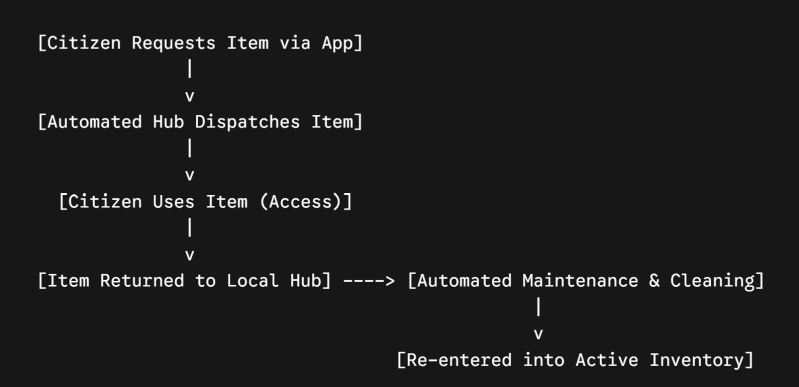
If an item is kept past its scheduled return window without a valid reason (e.g., holding onto a high-demand piece of specialized film equipment), the algorithmic grid flags the user. While there are no financial fines, the user's priority ranking for checking out high-demand items in that category may be temporarily lowered by the system to ensure fair access for others.
3. The Structural Benefits of Zero Ownership
By decoupling human well-being from the physical possession of objects, the Technate unlocks major thermodynamic advantages:
-
Engineering for Ultimate Durability: Because the Functional Sequences bear the carbon cost of maintaining and recycling everything, they have zero incentive to build cheap, disposable products. Everything is engineered to be rugged, easily repairable, and modular.
-
Massive Reduction in Raw Material Extraction: If 100 families share a pool of 10 high-efficiency, automated lawn/garden tools or 15 on-demand vehicles, the Technate only needs to expend the carbon to manufacture 10 to 15 units instead of 100. This dramatically lowers the baseline emissions, keeping the continent well within the 839 million tonne profile.
-
Elimination of Domestic Clutter and Theft: Crime involving property vanishes overnight. There is no point in stealing an object if everyone else can get the exact same object for free at a local hub, and there is no market where it can be sold or traded for profit.
The Cultural Shift: In this technocratic system, the human psychology shifts from "What do I own?" to "What can I do?" Security no longer comes from a locked vault or a bank account, but from the absolute scientific guarantee that the infrastructure will always provide whatever physical tool or space you need, exactly when you need it.
4. The "Access Over Ownership" Infrastructure
An individual ownership model creates immense carbon waste through redundant manufacturing. To stay well within the carbon budget, the technate must mandate a shared, on-demand physical infrastructure.
- Automated Product Libraries: Items like tools, transport vehicles, consumer electronics, and specialized gear are housed in automated, regional distribution hubs.
- The Logistics Loop: A citizen requests an item via a local terminal, uses it, and returns it to the hub. Sensors automatically check the item's wear and tear, factoring the tiny operational carbon cost of its maintenance into the regional budget.
- Zero Idle Waste: Because goods are constantly in circulation rather than sitting unused in private closets, the technate slashes total manufacturing requirements by up to 80%, massively reducing industrial carbon expenditures.
In a human-centric Technocracy, the shift to "access over ownership" cannot stop at the individual citizen. If organizations, industrial complexes, and administrative sequences were allowed to own their machinery, buildings, or raw materials, it would create massive, hoarding-driven inefficiencies that would immediately rupture the 2.2-gigaton carbon ceiling.
Therefore, every organization, research collective, and Functional Sequence is structurally legally barred from "owning" capital.
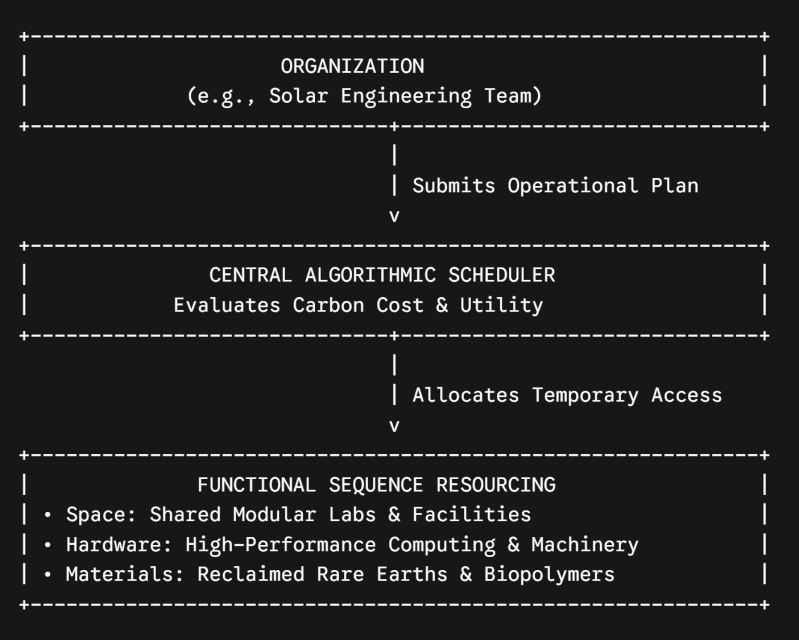
Instead, organizations operate on an Infrastructure-as-a-Service (IaaS) and Material-as-a-Service (MaaS) model, dynamically leasing physical capacity from the Technate's central grid.
1. How Organizations Access Resources
Rather than purchasing office space, factories, or computers, an organization (such as a medical research team or a localized agricultural cooperative) requests resources from the relevant Functional Sequence:
2. Key Pillars of Organizational Access
A. Dynamic Industrial Spaces
Organizations do not have static corporate headquarters. The Social Architecture Sequence manages modular, multi-use facilities.
-
A research group studying water filtration might be allocated a state-of-the-art laboratory for a six-month sprint.
-
Once their specific milestone is completed, the facility is automatically sterilized, reconfigured by modular robotics, and allocated to a biomaterials team. The space never sits empty or underutilized.
B. Fleet and Heavy Machinery Sharing
A construction collective does not own a fleet of excavators, nor does an agricultural team own harvesting tractors.
-
When a project is scheduled, the Continental Logistics Sequence dispatches the required autonomous machinery to the site.
-
The moment the task is complete, the machinery is routed back to a regional maintenance depot for diagnostic checks, cleaning, and reassignment. This keeps the active machinery pool tiny but incredibly high-yielding.
C. The "Material-as-a-Service" (MaaS) Pipeline
Raw materials are treated as physical assets on temporary loan from the planet.
-
If a robotics design group needs 100 kilograms of high-grade copper or lithium for a prototype, those materials are checked out from the central reserve.
-
When that prototype is retired or superseded by a better design, the organization is legally and operationally required to return the prototype to a disassembly hub. The copper and lithium are recovered, melted down, and re-allocated, ensuring a near-zero waste loop.
3. The Major Advantages for Organizations
Just like individual citizens, organizations find this model vastly superior to the administrative nightmare of ownership:
-
Zero Capital Expenditure: Starting a new initiative or scientific project requires zero funding, fundraising, or financial risk. If the idea is scientifically sound and fits within the carbon budget, the infrastructure is provided for free.
-
Frictionless Upgrades: An organization never has to worry about its hardware or machinery becoming obsolete. The Technate's engineering sequences continuously upgrade the shared pool of tools, computing nodes, and laboratory equipment, ensuring every group always has access to state-of-the-art technology.
-
Elimination of Overhead: Organizations do not need departments for procurement, facility management, corporate real estate, or asset depreciation. Their entire focus is directed purely toward their primary human-centric mission—whether that is curing a disease, designing a better turbine, or producing food.
The Structural Reality: By forcing organizations into an access model, the European Technate ensures that no single group can monopolize scarce physical resources. If a lab is not actively utilizing its high-performance computers or its physical space, the central grid automatically reclaims those assets and routes them to where they can actively reduce the continent's carbon footprint.
Human Centric Technocracy (continued)...
Human-centric technocracy directly merges scientific efficiency with community values. In this model, the community sets the ethical goals and retains ultimate approval, while the experts handle the technical execution.
How Resource Approval Works in this System
In a human-centric technocracy, resource management follows a clear, two-step process that preserves community power:
- The Community Sets the Mandate: The community holds the ultimate decision-making power. For example, the community decides that a specific piece of land must be used to provide free food for the neighbourhood while protecting the local ecosystem.
- Experts Design the System: Scientists and engineers use data, ecology, and technology to figure out the most efficient, sustainable way to achieve that exact goal.
- The Community Approves the Plan: The experts present their data-driven options back to the community. The people retain the final veto or approval, ensuring the technology serves human well-being rather than just cold efficiency.
Aligning with God's Law and Community Care
This hybrid approach solves major issues raised by both capitalism and pure technocracy, aligning closely with the values of community stewardship:
- Eliminating Profit and Greed: A human-centric technocracy removes the profit motive. Land and resources are treated as shared assets to be managed for the common good, not bought and sold for individual wealth.
- Guarding Against Robot-Like Efficiency: Pure technocracy can treat humans like numbers in an equation. By making it "human-centric," the system ensures that spiritual, ethical, and community needs (like rest, beauty, and charity) are programmed into the goals from the very start.
- True Stewardship: This model treats scientific knowledge as a tool for better stewardship. It uses human intelligence to manage God's creation as effectively as possible, while leaving the moral authority in the hands of the community.
In economic theory, the system we are outlining is often referred to as a "De-monetised Ecological State." In this specific model:
- The Currency is Carbon: The ultimate limit of human activity is based purely on the planet's physical carrying capacity (carbon and resource budgets), not on artificial financial money.
- No Markets or Credits: Because goods and services are free and unconditional, there are no market prices, no tradeable carbon credits, and no monetary wealth. Production is planned strictly to meet the basic survival needs of all citizens within that carbon boundary.
Technocracy Movement Under Attack!
Conflict of The Modern Era
From a pure technocratic perspective, what is happening today is not "technocracy" but the corporate capture of expertise. Here is why true technocrats argue that capitalists are merely "buying the brand":
1. The Co-opting of Language
Capitalists use technocratic terms like "efficiency," "data-driven," and "optimization" to justify their power. However, as a technocrat, you recognize that their "efficiency" is fake—it is only used to maximize shareholder profit (the Price System), not to maximize the physical throughput of goods for human use.
2. "Buying" the Technostructure
Modern billionaires (often called "Techno-authoritarians" or "Oligarchs") are effectively trying to hire the technical class to serve as a high-tech priesthood for their fortunes.
- Expertise as a Shield: They use "technical panels" and "expert boards" to bypass democratic oversight, framing political choices as neutral technical necessities.
- The "Price System" Trap: By paying technocrats in stock options and high salaries, they force these experts to remain loyal to the Price System. A true technocrat wants to abolish the very money being used to buy them.
3. Efficiency vs. Rent-Seeking
Technocrats and capitalists have fundamentally different views on technology:
- Technocrat Goal: Use technology to reduce the "cost" of living to near-zero energy units, creating abundance for everyone.
- Capitalist Goal: Use technology to create "Rent-Seeking" platforms (like subscription services or data-mining) that ensure users have to keep paying forever.
4. The Illusion of Modern "Technocracy."
Critics note that the "Technocratic Capitalism" described in 2025-2026 is often just managerialism in disguise. It uses algorithms to manage people, but the purpose of those algorithms is still to extract money. To a purist, a "capitalist technocrat" is a fraud because they refuse to let go of private property and the profit motive—the two biggest obstacles to total physical efficiency.
Create Your Own Website With Webador